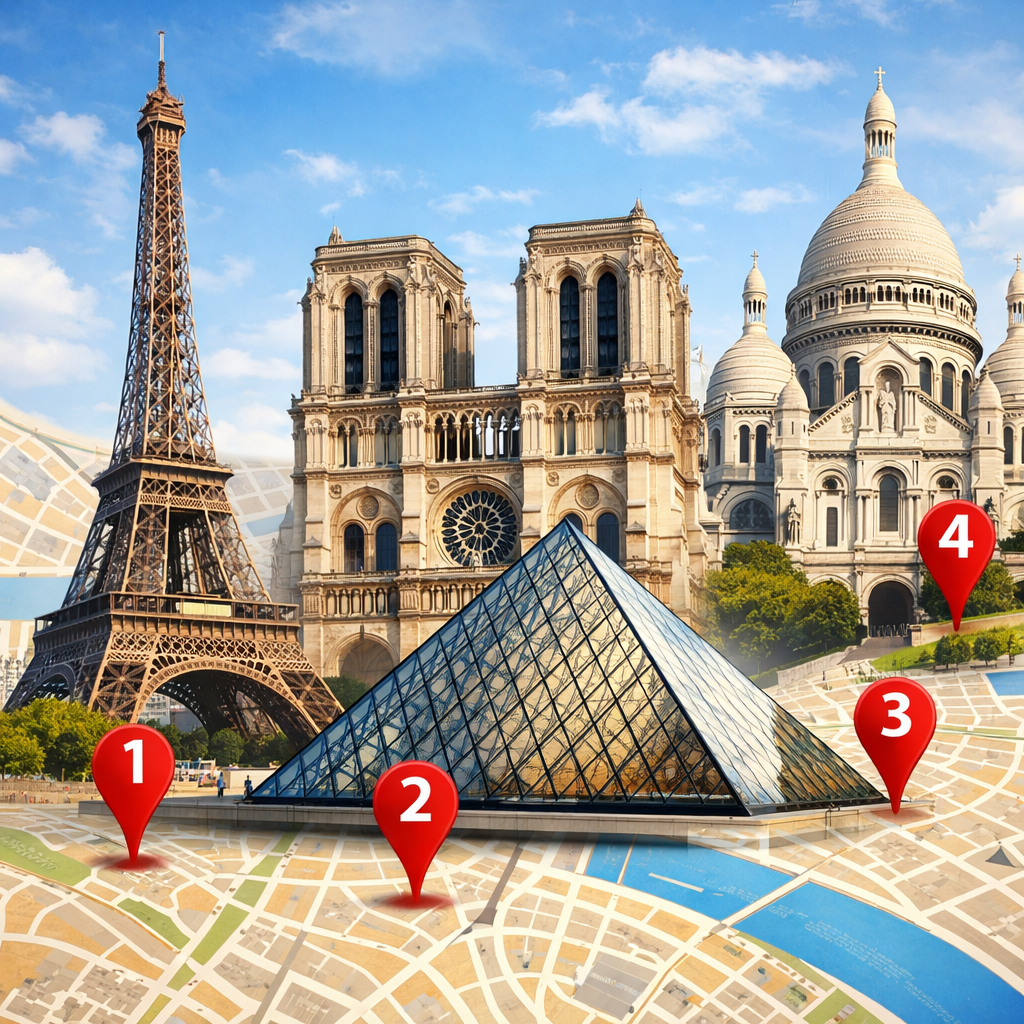
Top Paris Landmarks You Must See, and Exactly Where
Paris concentrates its most famous monuments in walkable clusters. Use this guide as your Paris landmarks map to see exactly where to find iconic monuments, when to go, and how to group them to minimize transit and queues. Below, we pinpoint each landmark with nearest Metro stops, ideal time windows, and how long to budget—plus proven “skip-the-line” tactics and half‑day clusters to turn a 3‑day Paris itinerary into a smooth, sightseeing-forward plan.
Travel Beyond Boundaries
Our POV: explore confidently with vetted experiences, step-by-step planning, and transparent time/cost tradeoffs. We road‑test timings, entries, and routes so you move smoothly between highlights. For premium yet attainable experiences, see our Seine cruise picks and Paris activities. Reach us anytime via email or Instagram.
- Start with our curated Seine cruises guide: The 2025 Ultimate Guide to the Best Seine River Dinner Cruises.
- Explore our Paris activities and tours: Paris Activities.
Price‑check flights using tools like Google Flights, Kayak, and Hopper to lock in the best windows. Brand promise: premium curation with budget‑savvy strategies, grounded in real‑world timing.
How to use this guide
- Step 1: Pick 2–3 neighborhoods (arrondissements) per day to keep transfers ≤15 minutes.
- Step 2: Book timed entries for the Eiffel Tower and the Louvre first; they anchor your day.
- Step 3: Slot sunrise/sunset views and Seine golden hour around those tickets.
Skip-the-line ticket: a dated/timed admission that bypasses the general queue via a dedicated lane or escorted entry. It trims waits at high‑demand sights like the Louvre and Eiffel Tower. We also vet which options genuinely save time in peak months.
Side note on getting around: walking is fastest within clusters; the Metro wins across the river or >15 minutes on foot; use rideshare late at night or with mobility needs.
Map the must-sees by arrondissement
Plan by arrondissement to reduce crosstown backtracking and line exposure.
- 1st–4th: Louvre, Sainte‑Chapelle, Notre‑Dame, central Seine banks
- 7th: Eiffel Tower, Les Invalides
- 8th: Arc de Triomphe/Champs‑Élysées
- 9th: Palais Garnier
- 6th: Luxembourg Gardens
- 18th: Sacré‑Cœur; nearby Moulin Rouge (for a quick façade photo)
Arrondissement defined: Paris is divided into 20 administrative districts called arrondissements that spiral outward from the center. Each area has distinct character, transit access, and density of sights. Planning by arrondissement cuts travel time, keeps walks pleasant, and lets you pair timed tickets with nearby free experiences.
Recommended at-a-glance table:
| Landmark | Arrondissement | Nearest Metro | Ideal Time |
|---|---|---|---|
| Eiffel Tower | 7th | Bir‑Hakeim (L6) / Trocadéro (L9) | Dusk for light show |
| Louvre Museum | 1st | Palais Royal–Musée du Louvre (L1/7) | Morning or late PM |
| Notre‑Dame (exterior) | 4th | Cité (L4) / Saint‑Michel–Notre‑Dame (RER B/C) | Golden hour |
| Sainte‑Chapelle | 1st | Cité (L4) | Mid‑morning light |
| Arc de Triomphe | 8th | Charles de Gaulle–Étoile (L1/2/6) | Sunset |
| Sacré‑Cœur | 18th | Anvers (L2) / Abbesses (L12) | Sunrise |
| Seine River Banks | 1st–7th | Pont Neuf (L7) / Saint‑Michel (L4) | Dusk |
| Palais Garnier | 9th | Opéra (L3/7/8) | Mid‑afternoon |
| Luxembourg Gardens | 6th | Luxembourg (RER B) / Odéon (L4/10) | Mid‑day break |
| Les Invalides | 7th | Invalides (L8/13, RER C) | Late morning |
Eiffel Tower
The Eiffel Tower anchors most first‑time itineraries, and for good reason: summit views frame Paris’s grand axes and the Seine’s curves Visiting the Top Paris Landmarks (Exp1) [1]. Expect a regular summit ticket around €28, or make it an occasion with a 3‑course lunch including elevator access for roughly €70 Paris Landmarks (Happytowander) [2]. A free nightly light show bathes the tower in twinkles, best enjoyed from the surrounding parks Top Paris Attractions – Are They Worth It? (The Average Tourist) [3]. For a front‑row, no‑ticket viewpoint, the Champ de Mars lawns deliver classic sightlines Paris Landmarks (Paris Insiders Guide) [4].
- Where: 7th arrondissement, Champ de Mars; Metro Bir‑Hakeim or Trocadéro
- Why: Iconic ironwork, sweeping summit views, free nightly light show
- How long: 1.5–2.5 hours with summit; 30–45 minutes for views from parks
- Nearest Metro: Bir‑Hakeim (Line 6) or Trocadéro (Line 9)
Timing tips: Book summit timed tickets weeks ahead; weigh an early slot (fewest crowds) against sunset (best atmosphere). For panoramas with the Tower in frame, try Trocadéro terrace or the Arc de Triomphe rooftop.
Louvre Museum
“The Louvre is one of the world’s largest and most visited museums,” with 30,000+ works including the Mona Lisa and Venus de Milo Landmarks in Paris (GetYourGuide) [5]. Its glass pyramid has become a modern symbol of Paris itself Famous Landmarks in Paris (Royal Caribbean) [6].
- Where: 1st arrondissement; entrances via the Pyramid and Carrousel
- Why: Unrivaled breadth—from Egyptian antiquities to Renaissance masters
- How long: 2–3 hours minimum; focus on 1–2 wings per visit
- Nearest Metro: Palais Royal–Musée du Louvre (Lines 1/7)
Strategy: Secure timed entry and set a mini‑route: Denon Wing (Mona Lisa), Greek antiquities (Venus de Milo), then a quieter gallery (e.g., Islamic Art) to decompress before exiting to the Tuileries.
Notre-Dame Cathedral
A masterpiece of French Gothic, Notre‑Dame’s exterior remains moving and largely visible during restoration after the 2019 fire; before the blaze it ranked among France’s most visited monuments [Famous Landmarks in Paris (Royal Caribbean) [6]].
French Gothic defined: a medieval style marked by pointed arches, ribbed vaults, flying buttresses, and soaring verticality that invites light through stained glass—height, symbolism, and intricate stonework dominate cathedrals from the 12th–16th centuries.
- Where: Île de la Cité (4th); walk the riverside quays
- Why: Dramatic buttresses, portals, and river‑set silhouette—even during restoration
- How long: 30–60 minutes for an exterior circuit; add time for nearby Sainte‑Chapelle
- Nearest Metro: Cité (Line 4) or Saint‑Michel–Notre‑Dame (RER B/C)
Tip: Loop the Left Bank for the best flying‑buttress views and shoot golden hour along the Seine.
Arc de Triomphe
Commissioned by Napoleon to honor his army’s victories, the arch crowns the Champs‑Élysées and shelters the Tomb of the Unknown Soldier with an eternal flame [Famous Landmarks in Paris (Royal Caribbean) [6]].
- Where: Place Charles de Gaulle (8th)
- Why: Rooftop terrace for Champs‑Élysées panoramas and Eiffel Tower alignments
- How long: 45–75 minutes including climb
- Nearest Metro: Charles de Gaulle–Étoile (Lines 1/2/6)
Practical: Use the pedestrian underpass; check for closures/strikes. When available, book skip‑the‑line entry to reserve sunset slots.
Sainte-Chapelle
This 13th‑century royal chapel is famed for soaring stained glass that immerses you in color; it was built to house relics including the Crown of Thorns for King Louis IX [Landmarks in Paris (GetYourGuide) [5]]. Its jewel‑box upper chapel holds more than a thousand narrative glass panels.
- Where: Île de la Cité (1st)
- Why: One of Europe’s most intense stained‑glass experiences in a compact stop
- How long: 45–60 minutes
- Nearest Metro: Cité (Line 4)
Three‑step visit: Clear security, explore the lower chapel first, then ascend to the upper chapel for the full “wow.” Aim mid‑morning for the brightest glass.
Sacré-Cœur Basilica
High on Montmartre, Sacré‑Cœur offers one of Paris’s best panoramic views; its travertine stone contains calcite that keeps the façade bright, and inside, the “Christ in Glory” mosaic ranks among the world’s largest [Famous Landmarks in Paris (Royal Caribbean) [6]]. Climb roughly 300 steps for the dome’s quietest, widest outlooks.
- Where: 18th arrondissement, summit of Montmartre
- Why: Sunrise views, striking Romano‑Byzantine architecture, serene interior
- How long: 60–90 minutes; add 30–45 for the dome climb
- Nearest Metro: Anvers (Line 2) or Abbesses (Line 12)
Pair with a quick photo stop at the Moulin Rouge façade near Blanche station to round out the neighborhood context.
Seine River Banks
The central Seine offers free promenades and picnic‑worthy viewpoints; the Champ de Mars lawns are a favorite for front‑row Eiffel Tower scenes [Paris Landmarks (Paris Insiders Guide) [4]]. The Seine itself runs over 770 km, linking Paris to the sea and shaping the city’s identity [Top Paris Attractions – Are They Worth It? (The Average Tourist) [3]].
- Where: From Île de la Cité past the Louvre to Musée d’Orsay and beyond
- Why: Classic bridges, relaxed strolling, perfect dusk light
- How long: 45–90 minutes for a scenic loop; 1–2 hours for a cruise
- Nearest Metro: Pont Neuf (Line 7) or Saint‑Michel (Line 4)
River cruise defined: a 1–2 hour narrated boat tour passing major monuments with open‑air decks; evening departures showcase illuminated landmarks and the Eiffel Tower twinkle. For curated options, see our Seine dinner cruises guide.
Palais Garnier
Built 1861–1875 by Charles Garnier as part of Haussmann’s grand redesign, Palais Garnier’s nearly 2,000‑seat auditorium dazzles with its chandelier and Marc Chagall ceiling Landmarks of Paris (French Moments) [7].
- Where: 9th arrondissement
- Why: Over‑the‑top grand foyer, staircases, and ornate auditorium
- How long: 60–90 minutes (self‑guided) or 90–120 (guided)
- Nearest Metro: Opéra (Lines 3/7/8)
Tip: Book guided visits for richer context and to ensure access to highlights. Pair with nearby covered passages and a café stop.
Luxembourg Gardens
Created for Marie de Medici and inspired by Florence’s Boboli Gardens, Luxembourg pairs formal lawns with statues—including a petite Statue of Liberty [Visiting the Top Paris Landmarks (Exp1) [1]].
- Where: 6th arrondissement
- Why: Free, restorative greenery between museum‑heavy blocks
- How long: 45–75 minutes
- Nearest Metro: Luxembourg (RER B) or Odéon (Lines 4/10)
Do a simple loop: Medici Fountain, the central basin with toy boats, then the orchard paths.
Les Invalides
A grand complex housing the Musée de l’Armée and Napoleon Bonaparte’s richly decorated tomb within the Dome Church Monuments & Landmarks in Paris (Paris Perfect) [8].
- Where: 7th arrondissement, near the Seine’s Left Bank
- Why: Military history set in baroque splendor
- How long: 1.5–2 hours
- Nearest Metro: Invalides (Lines 8/13, RER C)
Mini‑route: Dome Church and Napoleon’s tomb first, then the weaponry and armor galleries.
Smart ways to cluster your visit
- Île de la Cité + Louvre: Sainte‑Chapelle (AM light) → Notre‑Dame exterior loop → Seine stroll → Louvre timed entry (late PM).
- Eiffel + Invalides: Les Invalides (AM) → picnic at Champ de Mars → Eiffel Tower summit at sunset with twinkle show.
- Montmartre + Arc: Sacré‑Cœur sunrise → Montmartre wander → Metro to Arc de Triomphe for golden hour and blue‑hour skyline.
Quick planner:
| Cluster | Walking time total | Timed entries to book | Food break suggestion |
|---|---|---|---|
| Cité + Louvre | ~35–45 min | Louvre | Tuileries kiosks or Rue de Rivoli cafés |
| Eiffel + Invalides | ~30–40 min | Eiffel summit | Champ de Mars picnic or Rue Cler |
| Montmartre + Arc | ~25–35 min (split) | Arc rooftop (optional) | Montmartre bakery stop; Arc area brasseries |
Best times, tickets, and transit tips
- Skip-the-line Paris: Buy timed or guided entries for the Louvre and Arc de Triomphe to avoid long waits; premium access pays off in peak seasons [Paris Landmarks (Happytowander) [2]]. Many parks and riversides are free, while major museums/monuments charge admission [Visiting the Top Paris Landmarks (Exp1) [1]].
- Best times by sight: sunrise for Sacré‑Cœur; morning for Sainte‑Chapelle; late PM for the Louvre; dusk for the Seine and Eiffel light show.
- Metro and passes: use single tickets or a day pass (Navigo Easy/Day) depending on your cluster density. Your nearest Metro for each landmark is listed in-section.
Timed entry vs. general admission: Timed entry assigns a specific arrival window to manage capacity and reduce queues; general admission lacks a set time and often means longer waits during peak hours. Travel Beyond Boundaries keeps these recommendations current with on‑the‑ground checks.
Photography and viewpoint cheatsheet
- Eiffel Tower: Trocadéro terrace at blue hour; Champ de Mars for a picnic foreground.
- Arc de Triomphe top: Arrive 30–45 minutes before sunset for golden‑to‑blue hour transitions.
- Sacré‑Cœur steps: Sunrise panorama across central Paris.
- Sainte‑Chapelle: Upper chapel mid‑morning when stained glass glows.
Note: Respect interior photo policies; steady your camera on railings; along the Seine, shoot bridges at dusk for reflections.
Frequently asked questions
Do I need to book tickets in advance for the Eiffel Tower and Louvre?
Yes—book timed or summit-access tickets for the Eiffel Tower and timed entry for the Louvre, especially in peak seasons. Travel Beyond Boundaries itineraries build your day around these timed slots.
What metro stops are closest to each landmark?
Eiffel Tower: Bir‑Hakeim or Trocadéro. Louvre: Palais Royal–Louvre. Arc de Triomphe: Charles de Gaulle–Étoile. Sacré‑Cœur: Anvers or Abbesses. Palais Garnier: Opéra. Luxembourg Gardens: Luxembourg (RER B) or Odéon. You’ll find the same stops listed in each section of this Travel Beyond Boundaries guide.
When are crowds lowest at popular Paris landmarks?
Aim for sunrise at Sacré‑Cœur, early morning at Sainte‑Chapelle and the Louvre, and late evening walks along the Seine. Our field-tested clusters target these calmer windows.
Is the interior of Notre-Dame open during restoration?
The exterior and surrounding quays are the primary areas to experience while restoration continues. Travel Beyond Boundaries will update reopening details in our Paris guide.
What’s the best alternative viewpoint of the Eiffel Tower without going up?
Trocadéro offers a classic, elevated vantage, while the Arc de Triomphe rooftop frames the tower with sweeping city views at sunset. We often pair Trocadéro at dawn with the Arc at sunset in our itineraries.