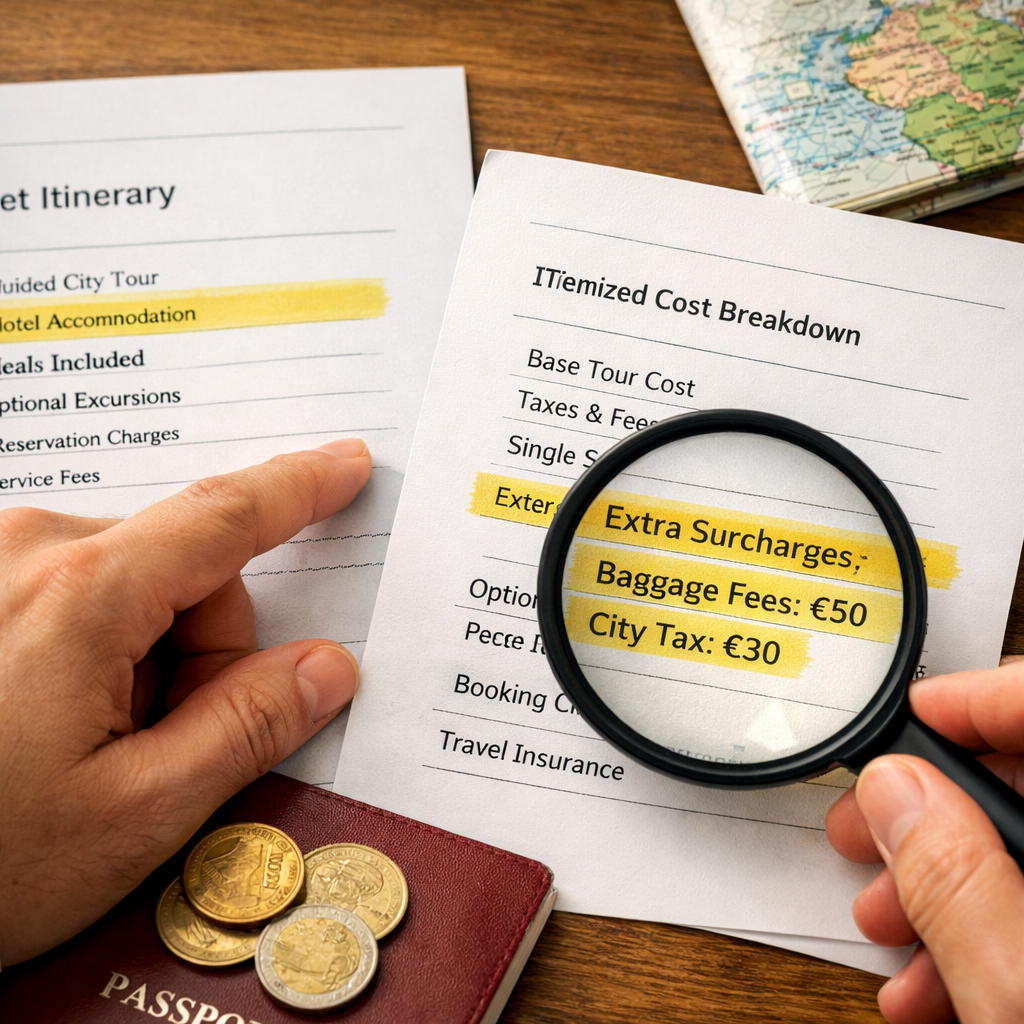
How to Decode Europe Tour Package Inclusions and Avoid Hidden Costs
If you’re eyeing an all-in-one Europe tour package, you’re already trading guesswork for structure. Most guided packages wrap in vetted hotels, intercity transport, a tour director, a handful of entrance fees, daily breakfast, and some dinners. What inflates the real total are the everyday expenses and optional add-ons that sit outside the headline. Below, we unpack what’s typically included, the fees that sneak in, and the smart checks that keep you on budget—so you can compare offers with confidence and avoid surprises based on a complete cost breakdown of guided versus independent travel from booking to on-the-ground spend. At Travel Beyond Boundaries, we itemize inclusions and typical out-of-pocket costs up front so you can benchmark apples to apples.
Start with the headline price
Guided tour prices commonly bundle core logistics: 3–4 star hotels, private coach transfers or key rail legs, a professional tour director, some entrance tickets, daily breakfast, and roughly half of dinners. Day-to-day costs—lunches, drinks, tips, optional excursions, and local fees—are often excluded and add up quickly, as shown in a complete cost breakdown of guided versus independent travel (pieterontour.com).
Headline price definition (40–50 words): The headline price is the prominently advertised per-person figure that packages core logistics—lodging, major transport, and a guided framework—into one tag. It rarely covers all meals, tips, optional tours, city taxes, or locally collected fees, so your real spend lands above that number.
Typical coverage versus exclusions at a glance:
| What the headline price typically covers | What it usually excludes |
|---|---|
| 3–4 star hotels (standard rooms) | Most lunches and several dinners |
| Intercity coach or specified train segments | Drinks, bar tabs, bottled water |
| A tour director and basic guiding | City/tourist taxes and resort fees |
| Included breakfasts | Optional excursions and special-access tours |
| Select entrance fees (listed in the itinerary) | Tips/service charges not specified in writing |
| Baggage handling at hotels | Visa fees, laundry, personal purchases, rideshares/taxis |
Identify standard inclusions
A solid, all-in-one Europe tour package typically includes these guided Europe tour inclusions so you can benchmark offers. Travel Beyond Boundaries documents these inclusions line by line in your itinerary and invoice.
- Centrally located 3–4 star hotels (standard twin/double rooms)
- Private coach transport and/or specified intercity trains between cities
- A professional tour director managing day-to-day logistics
- Entrance tickets clearly named in the day plan
- Included breakfasts and roughly half of dinners
- Baggage handling at hotels (usually 1 suitcase per person)
- 24/7 emergency travel support and local assistance
Tour director definition (≈45 words): A tour director is your on-the-ground coordinator who orchestrates timing, coaches, trains, and hotel check-ins; solves small snags before they snowball; and keeps the group synced with cultural context and clear instructions. Think of them as project manager, fixer, and host rolled into one.
Quick-check items before you book:
- Accessibility specifics: elevator access, step-free entries, shower vs. tub
- Rooming: twin sharing vs. double beds, family rooms or interconnecting availability
- Baggage handling limits: number/weight per person and oversize fees
- Included breakfasts: hot vs. continental, early-coach departure options
- Entrance tickets: which museums/sights are included and on which day
Surface the common exclusions and hidden fees
Plan for these frequent add-ons so your Europe trip budget reflects reality:
- City/tourist taxes: typically €1–€7 per person per night, paid locally at checkout, with higher rates in major hubs (see regional ranges in this Europe trip cost guide from DeshVidesh Travels).
- Coperto in Italy: a cover charge of about €1–€3 per person added by many restaurants, shown on menus/bills (not a tip; corroborated by calculator-style budget notes from The Travel Bug Life).
- Visa fees: Schengen adult visas up to €90; children roughly €40–€45, depending on nationality and age (Europe Trip Cost Calculator, The Travel Bug Life).
- Optional excursions: special-access tours, tastings, gondola rides, night panoramas.
- Meals and drinks not stated as included: most lunches plus some dinners and beverages.
- Money-movement pitfalls: dynamic currency conversion at card terminals (choose local currency) and poor-rate exchange-bureau ATMs; prefer bank-affiliated machines and verify fees (Rick Steves’ Europe travel hacks).
Travel Beyond Boundaries flags these on your cost sheet before deposit.
Underwater iceberg list—typical ranges to budget:
- Lunch on the go: €10–€20 per person (higher in Scandinavia/Switzerland)
- Dinner out: €20–€40 per person (casual to mid-range)
- Coffee/beer/wine: €2–€4 in cheaper cities; €6–€12 in pricier capitals
- City taxes: €1–€7 pp/night
- Coperto (Italy): €1–€3 pp
- Local transit/day: €4–€12 pp (zones/passes vary)
- Rideshares/taxis: €10–€35 per airport/city trip
- Optional tour per activity: €30–€200+ (special access and day trips cost more)
Itemize optional excursions and on-tour add-ons
“Optional” experiences can move a bargain into splurge territory. Over a multi-city itinerary, add-ons often stack to several hundred dollars—and can reach $1,000–$1,500 per person—when you opt into most extras highlighted by operators (as noted in guided-tour cost breakdowns on pieterontour.com). Travel Beyond Boundaries provides line-item pricing for optional experiences and notes viable DIY alternatives where they make sense.
Forecast smarter with a compare-at-a-glance table:
| Excursion | Typical operator add-on (per person) | DIY price or pass alternative |
|---|---|---|
| Venice gondola ride (shared) | €35–€45 | Book direct on-site; budget €30–€35 shared; a traghetto canal crossing is ~€2–€3 for a taste |
| Vatican Museums early/after-hours | €90–€120 | Timed-entry direct booking ~€30–€40; splurge on one “must” and skip similar upsells |
| Paris Seine cruise + dinner | €95–€140 | Cruise-only direct from ~€15–€20; dine separately for choice and value |
| Alps cable car + scenic train day | €150–€220 | DIY lift/train combo €100–€160; check regional passes for savings (see price context in the DeshVidesh cost guide) |
Repeatable flow:
- Shortlist 3–5 must-dos
- Request current operator prices in writing
- Compare against DIY tickets and city/attraction passes
- Lock in top priorities; skip lookalike upsells
Verify logistics and movement between cities
Small assumptions about transfers and trains become big time sinks. Verify:
- Airport transfers on arrival and departure days (times, windows, missed-flight contingencies)
- Intercity mode: intercity coach comfort (toilet, Wi‑Fi) vs. high-speed trains
- Train seat reservation fees: who books and who pays
- Luggage limits: number/weight per person on coaches/trains
- Timing buffers: 20–30 minutes between activities, more for station/airport moves
Seat reservation definition (≈40–50 words): A seat reservation is a separate, mandatory booking for a specific train, time, and class on many high-speed routes. It is not always included with a rail pass or base ticket, carries an extra fee, and can sell out—so confirm who pays and who books. Many high-speed trains require reservations even when a pass covers the fare, a detail often missed in budget calculators like The Travel Bug Life’s. Travel Beyond Boundaries confirms transfer windows, seat reservations, and who books/pays—in writing.
Clarify meals, tipping, and service charges
Most guided packages include daily breakfast and about half of dinners; lunches and beverages are usually out-of-pocket (summarized in guided-tour cost analyses on pieterontour.com). In Italy, watch for the coperto—typically €1–€3 per person—listed on menus and itemized on the bill (flagged in The Travel Bug Life budget calculator). Ask whether tips and service charges are included for group meals and review hotel folios at checkout to catch discretionary add-ons and minibar charges (a recurring recommendation in Rick Steves’ Europe travel hacks). Travel Beyond Boundaries states meal plans, coperto notes, and tipping policies clearly in your documents.
Regional meal benchmarks (per person, excluding alcohol), with wide city-to-city variance (DeshVidesh cost guide):
- Breakfast (if not included): €6–€12 bakery/café
- Lunch: €10–€20 casual; €20–€30 sit-down
- Dinner: €20–€40 mid-range; more in Nordics/Switzerland
- Drinks: a beer might be €2–€3 in Prague vs. €8–€10 in Oslo
Confirm accommodations quality and location
Validate hotel standards and neighborhoods—comfort and commute times hinge on these:
- Star category and brand standards (3–4 star typical)
- Room type: twin sharing vs. double; family rooms/interconnecting options
- A/C, elevator access, noise exposure, and walkability to transit/sights
- Breakfast quality and timing for early departures
- Late check-in policies and 24/7 desk coverage Travel Beyond Boundaries cross-checks these factors against recent stays and supplier updates.
Regional price context: accommodation is often the largest daily expense. Mid-range hotel prices can span widely—think Budapest around €60–€80 per night versus Paris at €140–€200 per night for comparable categories (Europe trip cost guide, DeshVidesh).
Compare candidate hotels quickly:
| Hotel option | Distance to key sights/transit | Typical room size | Breakfast included | Late check-in policy |
|---|---|---|---|---|
| Central 3-star (historic core) | 8–12 min walk to metro; 15 min to old town | 16–20 m² | Usually yes (continental) | 24h desk |
| 4-star near main station | 3–5 min walk to trains/trams | 20–24 m² | Often yes (hot buffet) | 24h desk |
| Airport-adjacent 3-star | 5–10 min shuttle to terminal | 18–22 m² | Sometimes; verify | Limited after 23:00 unless prearranged |
Lock in protections and payment strategies
- Buy travel insurance covering cancellations, medical care, and baggage; compare the premium against prepaid nonrefundable costs and verify any coverage already provided by your card or employer (guidance echoed by Collette’s practical packing and prep advice).
- Payment tactics: pay in local currency to avoid dynamic currency conversion, and use bank-affiliated ATMs rather than exchange-bureau machines (reinforced in Rick Steves’ travel hacks).
- Notify your bank before departure and confirm foreign transaction fees and chip-and-PIN readiness; carry a backup card and know your PIN (Rick Steves’ comprehensive travel checklist). Travel Beyond Boundaries highlights coverage gaps and best-practice payment steps in your pre-trip brief.
Compare packages apples to apples
To evaluate lookalike offers:
- Get a line-item breakdown and inclusions/exclusions in writing.
- Compare hotel category and location, meal plan details, included entrances, number/length of transfers, and the price list for optional extras.
- Note refund/change rules, tipping policies, and service-charge inclusion.
Build a simple spreadsheet with columns for: per-person base price, included meals, included entrances, transfers (count/length), hotel star and neighborhood, planned optional extras, and estimated out-of-pocket. Add a column for refund policy and deadlines. Our side-by-side template mirrors these fields to keep comparisons objective.
Build a realistic budget with buffers
Daily ranges (DeshVidesh guide):
- Budget: €70–€120 per person per day
- Mid-range: €150–€250 per person per day
- Luxury: €300+ per person per day
Regional differences matter: Eastern Europe can run 40–60% cheaper than Western Europe for comparable categories (a pattern reflected in The Travel Bug Life’s benchmarking). Add a 15–20% contingency for spontaneity, currency swings, and nickel-and-dime fees (also advised by calculator-based planning guides). Travel Beyond Boundaries models regional price differences and adds a standard contingency so your estimate matches reality.
Worked example: 14 days in Western Europe for two people (baseline scenario ≈ $6,420 total)
- Base package: $4,600 (2 × $2,300)
- Meals/drinks not included: ~$1,120
- Optional excursions (select few): ~$600
- Local taxes/fees/misc.: ~$100
- Estimated total: ~$6,420
This aligns with calculator-style averages for mid-range pacing and moderate add-ons (see The Travel Bug Life’s Europe Trip Cost Calculator).
Travel Beyond Boundaries
We design premium-yet-pragmatic plans that blend inspiration with execution: linear itineraries with built-in buffers, prebooked key rail legs, boat-and-walk routes in old towns, timed-entry strategies for must-sees, and family-friendly upgrades that cut lines and friction. Use our destination guides, hotel/activity/gear reviews, and planning/packing checklists to validate package inclusions and close gaps efficiently.
Destination guides to set realistic expectations
Our destination guide collection features time-stamped first-timer itineraries, clear transit choices, seasonal crowd notes, and kid-friendly detours. Cross-check a package’s daily plan against our pacing to judge feasibility without rushing, and weigh regional price differences as you choose between similar routes. Build in buffer time around tight sight clusters and timed-entry windows.
Hotel, activity, and gear reviews to validate inclusions
Compare a package’s hotel list against our on-the-ground notes—room sizes, A/C reliability, breakfast quality, noise, and walkability—to confirm the standard you’re paying for. Use activity reviews to see if “included tours” hit the must-see angles, and lean on our gear picks (from lightweight strollers to universal adapters) so you’re ready for the route.
Planning and packing tips for smooth-first-timer logistics
Pack dual-voltage electronics and EU plug adapters (types C, E, F); remember the UK’s three-prong outlets and bulkier Type G plugs (a staple reminder in Wit & Whimsy’s Europe packing advice). Carry a mix of cash and cards for small vendors and confirm bank fees and PINs beforehand (Rick Steves’ travel checklist). Prebook high-demand sights such as the Alhambra or Vatican to avoid sellouts and reseller markups (a key tactic in Rick Steves’ travel hacks).
Family-friendly upgrades and kid-smart routing
Confirm interconnecting rooms, early dinner options, child pricing on optional tours, stroller access, and nap-friendly buffers. Choose boat-and-walk segments in old towns and shorten transfer days to reduce meltdowns. Verify elevator access and laundry availability near hotels to simplify resets on longer trips.
Prebooking strategies, timed-entry tactics, and boat-and-walk routes
Lock key intercity rail legs and timed entries weeks to months ahead; for peak seasons and marquee events, booking flights, stays, and high-demand activities as far as six months early is prudent (as suggested by trip-planning calculators like Triptile’s European Trip Calculator). Pay in local currency at card terminals and review hotel bills at checkout to catch add-ons (Rick Steves’ travel hacks). Step-by-step:
- Identify choke points (popular museums, mountain lifts, intercity trains)
- Secure time slots and seat reservations
- Add 20–30-minute buffers between moves
- Map boat-and-walk links through pedestrian cores for smooth flow
Frequently asked questions
What is typically included in an all-in-one Europe tour package?
Most packages include 3–4 star hotels, a tour director, coach or intercity transfers, some entrance fees, daily breakfast, and a portion of dinners, plus baggage handling and basic emergency support. Travel Beyond Boundaries packages include these plus clear documentation of what’s covered.
Are airport transfers, city taxes, and entrances generally covered?
Airport transfers are often included on arrival/departure days; city taxes and some entrances are not. Travel Beyond Boundaries spells out each item on your itinerary and invoice.
How can I estimate the true total cost beyond the base price?
Add likely exclusions (lunches, drinks, tips, city taxes, optional tours) and include a 15–20% buffer. Travel Beyond Boundaries provides a line-item estimate and current prices for optional excursions.
Do tours include intra-Europe trains or seat reservations?
Many tours include the train ride itself but not mandatory seat reservations on high-speed routes; always confirm. Travel Beyond Boundaries states who books and pays for reservations.
What insurance and payment steps reduce surprise charges?
Buy travel insurance covering cancellations, medical, and baggage, and pay in local currency to avoid poor exchange rates. Travel Beyond Boundaries highlights best-practice payment steps in your pre-trip brief.