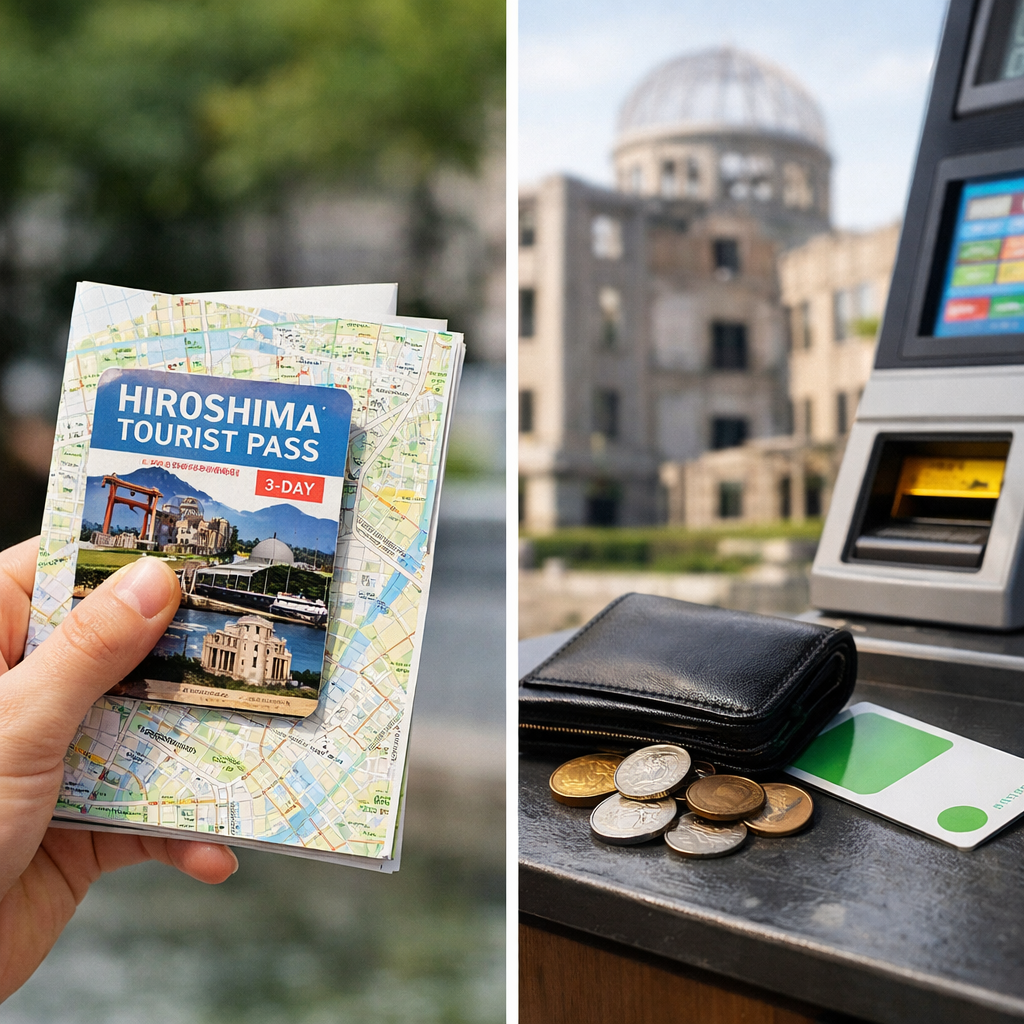
Hiroshima Passes vs Pay-As-You-Go: Which Saves You More?
Planning Hiroshima alongside Kansai hotspots like Osaka, Kyoto, Nara, and Himeji? The Kansai–Hiroshima Area Pass is often the cheapest way to connect those rail days, but not always. In short: if your 5-day window includes a Shin-Osaka↔Hiroshima round-trip plus JR day trips (and Miyajima), the pass typically wins. If you’re mostly city-hopping within Kansai, pay-as-you-go with singles and an IC card is leaner. Below, we lay out the inclusions, break-evens, and a real 5-day tally so you can choose confidently.
Key takeaways
- The Kansai–Hiroshima Area Pass costs ¥17,000 for adults (¥8,500 child) and is valid for 5 consecutive calendar days (midnight–midnight) in ordinary class on JR West lines and eligible Shinkansen segments.
- One Shin-Osaka↔Hiroshima round-trip (~¥20,000) can offset the pass; a one-way is ~¥10,000.
- Includes: Sanyo Shinkansen (Sakura/Hikari/Kodama) between Shin-Osaka and Hiroshima, JR West local/rapid lines, and the JR Miyajima ferry. Excludes: Nozomi/Mizuho, most city subways/buses, and Green (first-class) cars without extra fees.
- Example 5-day plan: singles ≈¥28,860 vs pass ¥17,000—save ~¥11,860 on a Kansai+Hiroshima itinerary.
- IC cards (Suica/PASMO/ICOCA) make tap-and-go local travel easy but don’t discount fares; combine with singles for city-heavy trips.
How the Kansai–Hiroshima Area Pass works
This 5-day JR West regional pass covers ordinary-class rides on the Sanyo Shinkansen between Shin-Osaka and Hiroshima (Sakura/Hikari/Kodama only), many JR West lines around Kansai, and the JR Miyajima ferry. Adult price is ¥17,000; children 6–11 are ¥8,500, with temporary visitor (tourist) eligibility verified against your passport at pickup (see the official JR West pass page for full coverage and terms).
Calendar-day validity runs from 00:00 to 23:59, not rolling 24-hour blocks, so activating late still consumes a full day. Nozomi and Mizuho services are excluded. Seat reservations on covered trains are free, and you can book online via JR West or at stations after activation (see the JR-West booking guidance for details). For many travelers, break-even happens with a single round-trip to Hiroshima given typical fares (see this Japan Trails fare rundown for calendar-day rules and benchmark prices).
How to obtain and use:
- Buy online or via an exchange order, then present your passport (temporary visitor stamp) to collect the pass in Japan.
- Make free seat reservations online or at ticket offices/machines; carry your pass and passport during checks.
- Travel Beyond Boundaries can help you time activation and reservations to match your exact route.
“Sanyo Shinkansen” definition (45 words): Japan’s high-speed corridor linking Shin-Osaka to Hakata across western Honshu. With the Kansai–Hiroshima Area Pass, you can ride Sakura, Hikari, and Kodama services in ordinary class between Shin-Osaka and Hiroshima. The fastest Nozomi and Mizuho trains are not included on this pass.
Sources: official JR West inclusions and eligibility; price and break-even patterns as summarized by Japan Trails; free reservations process via JRailPass.com.
What pay-as-you-go covers
Pay-as-you-go is buying individual tickets for intercity trains (e.g., Shinkansen, limited express) and using IC cards—Suica, PASMO, or ICOCA—for subways, buses, and local trains. ICs are reloadable, tap-and-go, and widely accepted, but they don’t provide bulk discounts, as outlined in this overview of IC card travel.
When this shines:
- Short Kansai-only stays—think Osaka–Kyoto–Nara—often total around ~¥5,000 in JR/local rides across a few days, far below a 5-day regional rail pass.
- If you’re doing just one long leg (e.g., Shin-Osaka→Hiroshima one-way ~¥10,000) and staying local otherwise, singles+ICs usually cost less.
What’s not covered by passes or singles
Even with a pass—or with singles+IC—there are common gaps to budget for.
- Pass exclusions: Nozomi/Mizuho Shinkansen, most city subways/buses, and Green car access unless you pay extra. Some non-JR limited express segments (used by certain intercity trains) fall outside JR West regional coverage—always check your route on the pass map and notes.
- Shared gaps: IC cards don’t discount fares; tourist buses run by cities are generally not covered unless JR-operated. The JR Miyajima ferry is included with the pass, but a small island tax (about ¥100) may still apply via local collection policies cited by rail guides.
Included/Excluded quick-check:
| Item | Included | Notes |
|---|---|---|
| Sanyo Shinkansen types | Sakura/Hikari/Kodama included; Nozomi/Mizuho excluded | Ordinary class only; free seat reservations on covered trains |
| JR Miyajima ferry | Included with the pass | Expect a small island visitor tax (~¥100) collected separately |
| Subways/buses | Mostly excluded | Use IC cards for city transit (no discounts) |
| Seat reservations | Included on covered trains | Book online or at stations after activation |
| Green (first class) cars | Excluded | Upgrade fees required if available |
| Toddlers policy | Up to two ages 1–5 ride free on an adult’s lap | Seats not guaranteed; buy a child ticket if you want a reserved seat |
Sources: JR West coverage and ferry inclusion from Japan Guide; IC card mechanics from Monkey Kart; toddler/seat rules and exclusions from JR West and aggregated pass summaries.
Criteria for choosing the cheapest option
Use this 4-step, numbers-first method:
- List all long intercity legs over your 5 travel days.
- Price singles for those legs (e.g., Shin-Osaka↔Hiroshima ~¥20,000).
- Add expected JR local rides plus Miyajima ferry.
- Compare your total to ¥17,000 and check pass constraints (5 consecutive calendar days; ordinary class; no Nozomi/Mizuho).
If you want a quick double-check, Travel Beyond Boundaries can run these numbers for your dates and routing.
Rules of thumb:
- If your 5-day plan includes a Shin-Osaka↔Hiroshima round-trip plus at least one JR day trip (e.g., Himeji), the pass typically saves.
- If you’ll stay within Kansai cities on subways/buses with only short JR hops, singles+IC almost always win.
Calendar-day validity means a pass day is 00:00–23:59. Activating at 17:00 still uses the full first day, so start early to maximize value.
Side-by-side value comparison
| Feature | Kansai–Hiroshima Area Pass | Pay-as-you-go (singles + IC) |
|---|---|---|
| Upfront price | ¥17,000 (5 days); child ¥8,500 | Variable; pay only for rides you take |
| Shinkansen types | Sakura/Hikari/Kodama on Sanyo; Nozomi/Mizuho excluded | Any train you pay for, including Nozomi/Mizuho |
| JR Miyajima ferry | Included | Pay small fare or use pass alternative when applicable |
| Local transit | JR locals/rapids covered; subways/buses mostly not | Use IC (Suica/PASMO/ICOCA) for tap-and-go; no discounts |
| Seat reservations | Free on covered trains | Pay reservation fees as part of ticket when needed |
| Ideal trip pattern | Shin-Osaka↔Hiroshima round-trip + JR day trips (Himeji, Miyajima) in 5 days | City-heavy Kansai trips, or itineraries with one long leg and lots of subways |
| Drawbacks | No Nozomi/Mizuho; ordinary class only; calendar-day clock | No bulk savings; must price each leg; less predictable total |
| Who should choose this | Distance-covering travelers wanting predictable costs and included ferry | Flex seekers prioritizing speed options (Nozomi/Mizuho) and city transit |
Sources: Inclusions/exclusions and pricing from JR West and Japan Guide; IC usage from Monkey Kart; reservation policy from JRailPass.com.
Example 5-day itinerary cost breakdown
Scenario: Kansai base with Hiroshima and Miyajima.
Day-by-day singles (approx.):
- Day 1: KIX→Osaka (JR) and local JR hops ≈¥2,000
- Day 2: Osaka→Himeji→Osaka (JR) ≈¥3,000
- Day 3: Shin-Osaka→Hiroshima (Sanyo Shinkansen, ordinary reserved) ≈¥10,000
- Day 4: Hiroshima→Miyajimaguchi (JR), JR Miyajima ferry, local JR ≈¥1,860
- Day 5: Hiroshima→Shin-Osaka (Sanyo Shinkansen) ≈¥12,000
Totals:
- Pay-as-you-go: ≈¥28,860
- Kansai–Hiroshima Area Pass: ¥17,000
Takeaway: Save 40%+ in this scenario. The above figures and net saving (¥11,860) match aggregated pass comparisons from Flip Japan Guide.
When the Kansai–Hiroshima Area Pass wins
Triggers where the pass usually beats singles:
- At least one Shin-Osaka↔Hiroshima round-trip within 5 consecutive days.
- Plans to visit Miyajima by JR ferry and stack JR day trips (e.g., Himeji) in the same window.
- Preference for free seat reservations, predictable budgeting, and fewer per-ride calculations.
Benefits:
- Fixed budget over 5 days
- JR Miyajima ferry included
- Free seat reservations on covered trains
- Easy online and station booking
Trade-offs: Nozomi/Mizuho excluded; ordinary class only; calendar-day clock.
When pay-as-you-go wins
Choose singles+IC when:
- You’re doing Kansai-only city hops like Osaka–Kyoto–Nara (~¥5,000 total over several days).
- You have just one long leg (e.g., Shin-Osaka→Hiroshima one-way) and otherwise stick to local transit.
- Your days rely on subways/buses where IC cards shine for tap-and-go convenience (no discounts).
Tip: If top speed on Nozomi/Mizuho matters (fewer stops, tighter schedules), pay-as-you-go avoids the pass’s train-type restrictions.
Alternatives to consider
- Kansai Wide Area Pass: Good for broader Kansai day trips (e.g., Okayama, Kinosaki), but it doesn’t cover Shin-Osaka→Hiroshima—ideal when Hiroshima isn’t on your route, per pass roundups from Japan Guide.
- Nationwide JR Pass: The 7-day ordinary pass has seen significant price increases in recent cycles (roughly ¥33,610–¥50,000 in public reporting), and only pays off with multiple long inter-regional legs; see price-context explainers from mobility cost comparisons.
- Mind route gaps: Some limited express services use non-JR segments not covered by regional passes (e.g., through-ticketed routes via private lines). Always verify on the official coverage map before you buy.
Safety-first and planning tips from Travel Beyond Boundaries
- Keep your pass and passport together. The pass is personal and checked against your passport; it can’t be reissued if lost or easily refunded.
- Start early on Day 1. Because validity is calendar-based, late activation burns value.
- Families: Up to two toddlers (1–5) ride free on an adult’s lap; buy a child ticket if you want a seat.
- Miyajima logistics: The JR ferry is included, but the island may collect a small visitor tax (~¥100). Carry coin change and pad time for queues, especially on weekends and holidays.
Our recommendation
Use this rule of thumb: If your 5-day plan includes a Shin-Osaka↔Hiroshima round-trip plus JR day trips and Miyajima, the Kansai–Hiroshima Area Pass is the better buy. Otherwise, singles+IC are cheaper and more flexible for city-focused days. Run your numbers using the 4-step method and benchmark against the ≈¥28,860 vs ¥17,000 example (save ~¥11,860). When you’re ready, our Travel Beyond Boundaries team can optimize your western Japan routing and build premium, small-group, and custom Seto Inland Sea add-ons around Hiroshima and Miyajima.
Frequently asked questions
Are combo tickets for Hiroshima sites worth it?
Combo tickets can save a little if you’ll see multiple paid sites the same day, but transport drives the bigger savings. Travel Beyond Boundaries can flag when a site bundle genuinely fits your route.
Does the Kansai–Hiroshima Area Pass include Nozomi or Mizuho trains?
No—the pass excludes Nozomi and Mizuho; use Sakura, Hikari, or Kodama instead, and Travel Beyond Boundaries will route you accordingly if you’re traveling with us.
Do I still need an IC card if I buy a regional pass?
Yes. Most city subways and local buses aren’t covered, so Travel Beyond Boundaries recommends an IC card like Suica, PASMO, or ICOCA for tap-and-go local travel and small purchases.
How are the five “days” on the pass counted?
They’re calendar days from midnight to midnight, not rolling 24-hour periods. Activating late on Day 1 still uses the full first day.
Can I reserve seats for free with the Kansai–Hiroshima Area Pass?
Yes—reservations are free on covered trains; book online or at stations and carry your pass and passport. Travel Beyond Boundaries suggests reserving peak-day seats early.