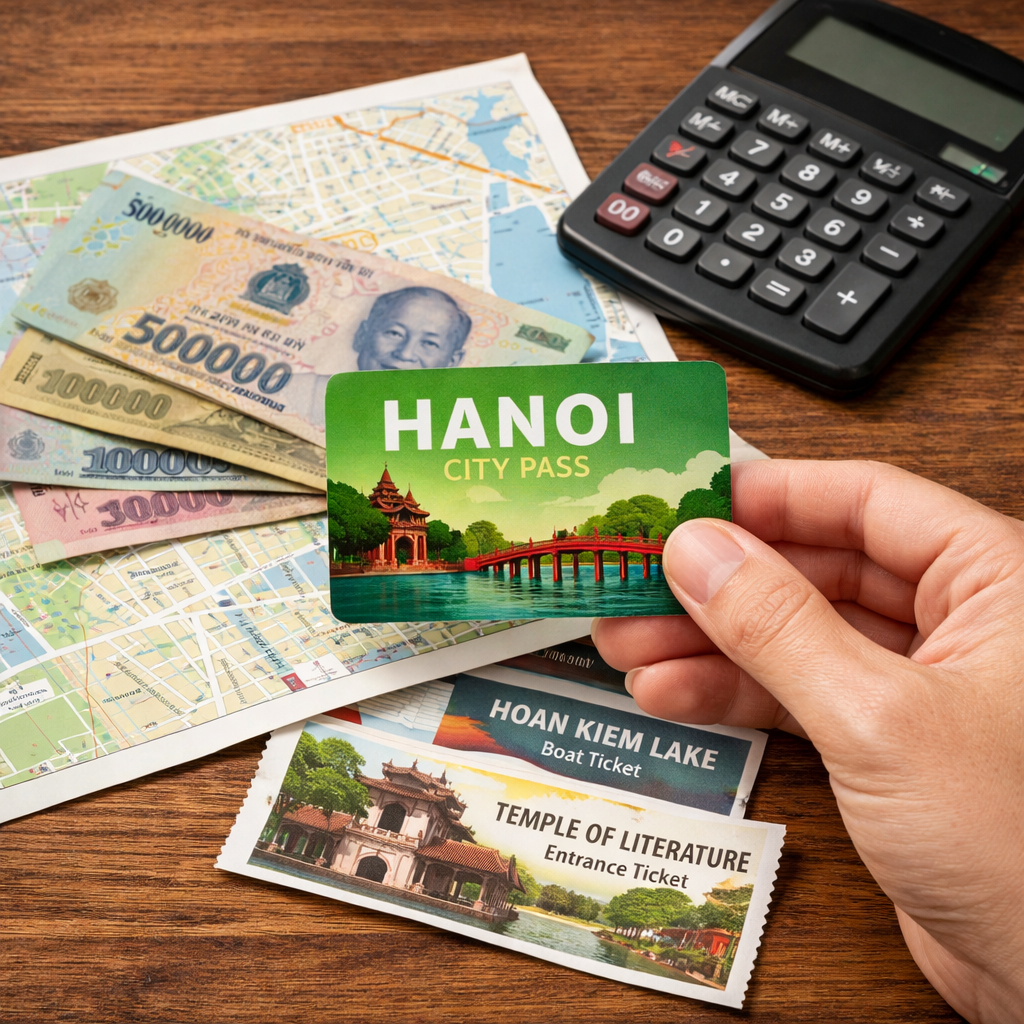
Are Hanoi City Passes Worth It? Honest Cost-Benefit Breakdown
Hanoi is a city where you can see a lot for surprisingly little. That’s why the honest answer to “Are Hanoi city passes worth it?” is usually no—unless a bundle folds in high-value tours or time-saving transfers. Most individual entries cost only a few dollars, and short rides are cheap, so à la carte planning wins for many travelers. Passes can make sense if you have 1–2 days, want an easy overview without planning, or you’re buying a bundle that includes a Ha Long Bay tour or guided experiences with transport. Below, we break down what a Hanoi city pass actually covers, real costs, clear breakeven math, and quick decision steps so you can buy with confidence—or skip without FOMO.
Quick answer
For most travelers, generic Hanoi city passes don’t deliver savings because individual attraction fees typically run about $1–$5 and short rides (e.g., Grab) average roughly $2–$4, keeping daily sightseeing costs low for independent explorers, per a Vietnam travel costs overview (AmigoSIM cost guide). The exception: bundles that include higher-ticket items—like a Ha Long Bay day cruise or guided tours (often $25–$70+)—can be worth it, especially on short, activity-heavy stays. One-line rule: total your planned entries, tours, and transport; if a pass/bundle is ≥10–15% cheaper or clearly reduces logistics, buy it—otherwise, go à la carte. If you’re on the fence, Travel Beyond Boundaries can map your plan and price both paths in minutes.
What counts as a Hanoi city pass
“A Hanoi city pass is typically a hop-on hop-off bus ticket that gives 24–48 hours of unlimited rides and multilingual audio across major sights. Unlike classic all-inclusive passes, it usually excludes attraction entry fees, the Hanoi metro or public buses, and regional tours or transfers.”
Hanoi doesn’t have a universal, attractions-plus-transit pass common in some capitals. The closest equivalents are hop-on hop-off Hanoi products that provide sightseeing loops, commentary, and convenience but limited bundle value. When it helps, Travel Beyond Boundaries folds these passes into itineraries alongside tours that actually change the value equation.
Typical inclusions:
- Unlimited bus loops during validity
- GPS-based audio guide, basic maps, onboard Wi‑Fi
- Major-stop coverage (Old Quarter, Hoan Kiem, West Lake corridors, key museums)
Common exclusions:
- Museum/temple entries and “skip-the-line Hanoi” privileges
- Public transit (bus/metro) integration
- Regional day trips (e.g., Ha Long Bay) or airport transfers
How Hanoi sightseeing costs add up
Baseline costs are low. Many museum and temple entries run about $1–$5, while short Grab hops are roughly $2–$4, so daily sightseeing often stays modest without a pass (AmigoSIM). The Old Quarter and Hoan Kiem area are dense and walkable, letting you stack sights and street food for minimal outlay (see the New York Times’s guide to Hanoi attractions: Things to Do in Hanoi).
Day tours are the outlier. Organized experiences often start around $25–$40 and rise for premium options or longer distances; a Ha Long Bay tour commonly pushes the higher end once transfers and lunch are included.
Real-world anchor: one traveler logged about $228 per person for 6 days/5 nights in Hanoi, all-in—showing how low independent costs can be when you walk, eat locally, and pick a few paid sights (six-day spend report).
When a pass makes sense
- You have 24–48 hours and want to cover far-flung landmarks with minimal planning, using onboard audio for light context.
- You’ve found a bundle that explicitly includes higher-value tours (e.g., a food tour, Ha Long Bay day cruise) or transfers—convenience and large-ticket inclusions can flip the math.
- You favor the “hybrid experience” trend—curated day activities paired with comfort at night—where bundled logistics reduce friction while keeping quality high (Vietnam 2026 travel trends).
When you should skip the pass
- Your plan is mostly walking the Old Quarter, Hoan Kiem Lake, and a few low-cost temples/museums; paying as you go is cheaper and more flexible (see the concise Hanoi travel guide).
- For Grab vs bus Hanoi, door-to-door Grab rides are fast and inexpensive for short hops; passes that don’t integrate public transit rarely beat the convenience-price combo.
- You only enter 2–3 paid attractions after “over-researching.” You likely won’t hit the breakeven threshold.
Sample itineraries and breakeven math
Below are simple, apples-to-apples examples. Where a pass excludes entries, we add them to the pass column so totals are comparable.
| Scenario | Activities | À la carte total | Pass price | Net difference | Worth it? |
|---|---|---|---|---|---|
| 24-hour Landmarks Blitz | 8 paid entries ( | $36 | 24h hop-on hop-off ~$25 + entries $24 = $49 | -$13 | No |
| 48-hour Selective Highlights | 5 entries ( | $33 | 48h hop-on hop-off ~$35 + entries $15 = $50 | -$17 | No |
| Tour-Heavy Weekend | Food tour | $129 | Example bundle including food tour + Ha Long Bay transfers ~$99 + entries $12 = $111 | +$18 | Yes |
Assumptions:
- Entry fees average $3; short rides $3.
- Hop-on hop-off passes typically don’t include entries.
- The “bundle” is illustrative; always verify inclusions (tours, transfers, timing).
Breakeven checklist:
- Count how many stops you’ll actually enter (not just see).
- Tally realistic ride count (and whether a pass replaces those rides).
- Confirm if bundled transfers replace multiple taxis or a long round-trip.
Transit considerations in Hanoi
Hanoi is motorcycle-dominated with congestion and pollution; the bus network spans nearly 4,000 km but still relies on feeder links and multimodal upgrades, and coordination between transport and development agencies remains weak—limiting seamless interchanges and integrated ticketing (Hanoi transport diagnostic). Unless a pass demonstrably knits together your specific metro/bus patterns, short Grab rides remain time-efficient and cost-effective for many visitors. For first-timers comparing Grab vs bus Hanoi, the former usually wins on door-to-door speed; buses save money but require route literacy and buffer time.
Time and convenience benefits to weigh
The time-value premium is the extra you willingly pay to reduce trip friction: fewer ticket queues, simpler route decisions, bundled transfers, and predictable schedules. If your time is tight or you’re traveling with kids or elders, a modest premium can unlock more sights and a calmer day.
This matters most in humid afternoons, peak-hour congestion, or with multigenerational groups where one-ticket simplicity reduces fatigue. Check actual bus frequency, route density, and how close stops are to entrances; if you still need 10–15 minutes of street crossings at each stop, your “convenience” may evaporate. Skip-the-line Hanoi perks are limited, so don’t overvalue them in pass marketing.
Safety-forward and accessibility notes
- Use verified vendors, digital tickets, and official pickup points to avoid overpricing or bait-and-switches; Vietnam can “look cheap” online, but on-the-ground hassles vary—plan realistically and watch for common pitfalls (avoid scams video).
- Central Hanoi (Old Quarter/Hoan Kiem) is walkable but expect uneven pavements, curbs, and scooter traffic. Build extra time and consider direct transfers between distant sites.
- Prioritize daylight transfers, shared meeting pins, and contingency buffers—especially in high-density zones (city-center density is roughly 12,425 people per km² per the transport diagnostic).
Travel Beyond Boundaries recommendations
- For most travelers: walk the core, pay entries à la carte, and use Grab for longer hops. Invest in targeted, high-impact experiences (a vetted food tour, a vetted Ha Long Bay tour) rather than generic passes.
- For short stays or small groups: consider a hop-on hop-off overview on arrival day to orient, then pivot to curated tours with vetted operators—aligned with the hybrid comfort-plus-experience trend.
- Our custom trip design bundles smart transfers, timed museum slots, and hard-to-book dining (including Michelin-caliber spots), all on a safety-forward schedule built for Hanoi’s real-world traffic and heat.
How to decide in five minutes
- Step 1: List paid activities and their standalone costs (entries $1–$5 each; common day tours $25–$40; Ha Long Bay from ~$70 with transfers).
- Step 2: Estimate transport (short hops × $2–$4 per ride, or motorbike rental $5–$10/day).
- Step 3: Compare your sum to the pass price and verify inclusions (tour entries, transfers, frequency). If the pass/bundle saves ≥10–15% or meaningfully reduces logistics, buy; otherwise, skip.
- Step 4: Sanity-check against your time-value premium and group needs (kids, mobility, humidity/traffic buffers).
If you prefer a quick expert check, Travel Beyond Boundaries can run the breakeven and map the simpler option.
Frequently Asked Questions
Does Hanoi have an all-inclusive city pass like other capitals
Not typically; most options are hop-on hop-off bus passes with audio guides but without bundled attraction entries or metro/bus integration. Travel Beyond Boundaries can flag any short-term bundles that genuinely add value.
Are hop-on hop-off passes worth it for a short stay
Sometimes: for a 24–48‑hour overview across dispersed stops, the convenience helps. Travel Beyond Boundaries typically pairs a brief orientation loop with targeted tours; otherwise, walking plus short rideshares is cheaper.
Will a pass cover Ha Long Bay or guided tours
Usually no. Book Ha Long Bay cruises and guided tours directly, or choose a clearly stated bundle that includes them end‑to‑end; Travel Beyond Boundaries can package tours and transfers when that’s better value.
What’s the cheapest way to get around without a pass
Walk the Old Quarter core and use short Grab rides for longer hops; you’ll only pay for what you use. Travel Beyond Boundaries routes days to minimize backtracking and rides.
How do I avoid overpaying or getting stuck with unusable vouchers
Buy from verified platforms, double-check validity windows and bus frequency, and confirm exact inclusions. If details are vague, go à la carte or use Travel Beyond Boundaries–vetted, curated tours.