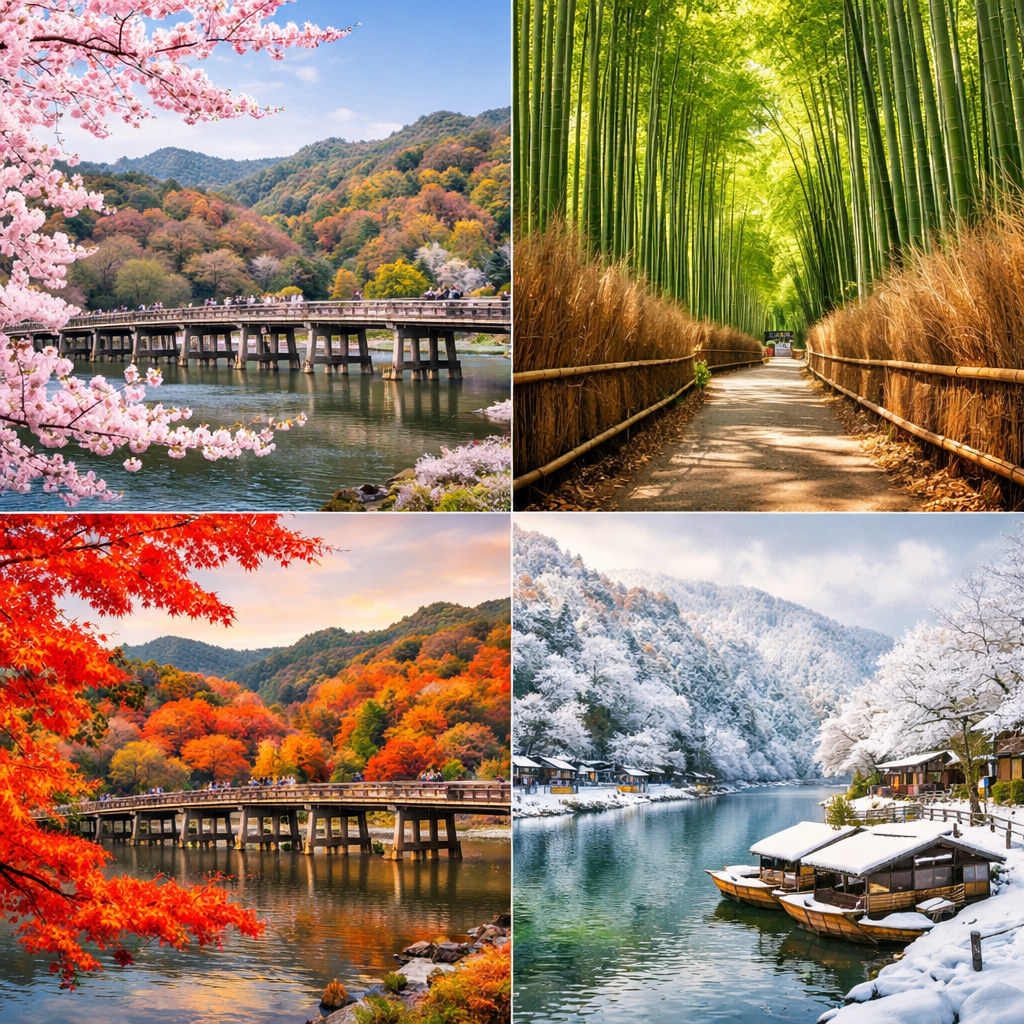
Arashiyama in 2026: When Kyoto’s Scenery Peaks by Season
Kyoto’s Arashiyama changes character with every season, but the “best” time depends on your priority. For iconic photos, spring’s cherry blossoms deliver a short, dazzling spectacle. For richer, longer-lasting color, late November into early December is the safer bet. If you want quieter paths and better value, choose summer greens or winter’s serene minimalism. For 2026, expect sakura in late March–early April and the strongest autumn color from mid‑November into early December. To experience the Bamboo Grove without shoulder‑to‑shoulder crowds, arrive between 6:00 and 8:00. This Travel Beyond Boundaries guide turns those headline choices into clear routes, smart timing, and low‑friction logistics.
Quick answer for first-timers
- If you want the most iconic scenery: Spring (sakura). Peak bloom lasts ~7–10 days and crowds surge, but the visuals are unforgettable, especially around Togetsukyo Bridge and the riverbanks, with shaded relief in the Bamboo Grove during early hours, per this 2026 Arashiyama guide (machupicchu.org).
- If you want deeper color with more flexibility: Autumn. Peak momiji (maples) often holds for 3–4 weeks, allowing better planning around Tenryu‑ji, Jojakko‑ji, and Gio‑ji (machupicchu.org).
- If you want fewer people and lower costs: Summer or winter. Expect 40–60% fewer visitors in summer’s tsuyu period and the calmest ambience in winter (machupicchu.org).
2026 at a glance
- Sakura: Late March–early April; likely peak March 25–April 3, based on Kyoto bloom patterns and tracking methods in this Kyoto cherry blossom guide (travelcaffeine.com).
- Autumn foliage: Mid‑November to early December, with late‑peak risk extending to early December in 2026 per Arashiyama festival timing insights (umetravel.com).
Peak window defined (40–50 words) The peak window is the brief period when seasonal scenery is most vivid—full cherry blossom bloom or maximum maple coloration. In Arashiyama, sakura’s peak typically holds for 7–10 days, while autumn color often endures for 3–4 weeks, offering slightly more planning flexibility (machupicchu.org).
How seasonality shapes the Arashiyama experience
- Spring: Arashiyama’s best season for classic sakura views—and its busiest. Crowds can swell severalfold versus shoulder months; book 3–4 months ahead (machupicchu.org).
- Summer: Hot, humid tsuyu brings lush greens and 40–60% fewer visitors; early morning shade in the Bamboo Grove helps (machupicchu.org).
- Autumn: Deep momiji color at Tenryu‑ji, Jojakko‑ji, Gio‑ji; peak typically mid‑Nov–early Dec and can push later (machupicchu.org; umetravel.com).
- Winter: Minimalist frames, clear air, and Tenryu‑ji’s shakkei shining after a light snow; calmest crowd levels (machupicchu.org).
Tsuyu (rainy season) defined (40–50 words) Tsuyu is Japan’s early‑summer rainy period, usually starting in June. In Kyoto and Arashiyama it brings warm temperatures, high humidity, and frequent showers that keep the bamboo and moss vivid. Early mornings often deliver the most comfortable conditions and photogenic breaks between showers (machupicchu.org).
Spring peak window
Spring in Arashiyama is short but spectacular: cherry blossoms crest for roughly a week, and Bamboo Grove crowds build fast after 8:00. For graceful variety, pair Togetsukyo Bridge views, a riverbank stroll, and shaded bamboo lanes—moving at dawn to stay ahead of tour waves.
High‑yield mini itineraries
- Dawn classic (2.5–3 hours): Start 6:00 at Torokko Saga‑Arashiyama area → slip into the Bamboo Grove before 7:00 → exit toward Tenryu‑ji’s outer paths → reach Togetsukyo by 8:30 for soft light across the Katsura River.
- River‑first loop (3–4 hours): 6:15 sunrise along the Katsura north bank → cross Togetsukyo for long shots → weave back through side lanes into the bamboo by 7:30–8:00 → café break before temple gardens.
2026 sakura timing and variability
Forecast: Late March–early April with a likely peak around March 25–April 3 for Kyoto’s main cherry areas, a pattern supported by historical tracking and on‑the‑ground tips in the Kyoto cherry blossom guide (travelcaffeine.com). Arashiyama concentrates roughly 1,500 cherry trees around the shopping lane and Togetsukyo zone, amplifying bloom density and foot traffic (travelcaffeine.com). Track Japan Meteorological Corporation updates and local Kyoto advisories and be ready to shift plans ±3–5 days.
Best viewing routes and crowd timing
Go dawn‑first:
- 6:00–7:30 Bamboo Grove via the Torokko Saga‑Arashiyama side to avoid compressing flows.
- Before 9:00, capture Togetsukyo Bridge and riverbank reflections while paths are still breathable (machupicchu.org).
Mid‑morning add‑on: Ride the Sagano Scenic (Romantic) Train for river and sakura‑tunnel angles once walking paths fill (travelcaffeine.com).
Backup frames for wind or drizzle
- Katsura River reflections under overcast light
- Long shots from Togetsukyo Bridge
- Telephoto peeks through side alleys and temple gates
Booking, permits, and timed entry strategy
Reserve spring accommodations 3–4 months ahead; expect dynamic inventory and stricter cancellation terms at peak (machupicchu.org). Kyoto’s accommodation tax was revised in 2026, with tiered nightly amounts (roughly ¥200–¥10,000) that weigh more on longer or luxury stays; verify inclusions at booking and settlement at check‑in, a trend echoed in travel policy coverage on crowd management (travel.yahoo.com). Travel Beyond Boundaries coordinates dawn‑first starts with any available timed entries and tracks Kyoto inventory shifts so you can book with fewer surprises.
Timed entry defined (40–50 words) Timed entry assigns a specific arrival slot to distribute visitors and smooth queues. During sakura, pairing a dawn start with prebooked windows (where offered) shortens waits, preserves soft light, and helps you bypass the mid‑morning surge that squeezes Bamboo Grove paths (machupicchu.org).
Summer green calm
Summer reframes Arashiyama as value‑forward: 40–60% fewer visitors than the peaks, emerald temple gardens, and naturally shaded bamboo lanes (machupicchu.org). Expect highs around 32–35°C and 70–80% humidity; June is tsuyu. The 6:00–9:00 window dramatically improves comfort and images.
Weather, comfort windows, and shade routes
Adopt a split‑day rhythm:
- Dawn: Bamboo Grove and river walks (6:00–9:00).
- Midday siesta: 11:00–15:00 indoors.
- Late return: Golden‑hour temple gardens and bridge views.
Shade‑max route
- Bamboo Grove → Gio‑ji’s mossy lanes → riverside breezes along the Katsura.
Pack cooling towels, a hat, and electrolytes; pause in air‑conditioned cafés when humidity spikes.
Rain plans and photography tips
Wet‑weather loop
- Covered shopping street for intermittent showers → Tenryu‑ji’s covered corridors → Gio‑ji for saturated greens, with café stops during downpours.
Photo tactics
- Shoot just after rain for mirror‑like puddles, saturated bamboo, and low‑glare reflections.
- Use a lens hood and microfiber cloth; keep a compact rain cover handy.
Microclimate defined (40–50 words) A microclimate is a localized climate that differs from its surroundings due to terrain, vegetation, and water. In Arashiyama, dense bamboo, mossy temple grounds, and the Katsura River create cooler, calmer pockets—especially at dawn—versus Kyoto’s exposed streets, improving both comfort and image quality (machupicchu.org).
Autumn color crescendo
Autumn is Arashiyama’s longest “wow” season: peak often falls Nov 20–30 with ±5–7 day shifts, and in 2026 reds may hold into early December (machupicchu.org; umetravel.com). Momiji maples drive the palette at Tenryu‑ji, Jojakko‑ji, and Gio‑ji, layering reds against green moss and dark timber.
2026 koyo outlook and late-peak risk
Expect a 3–4 week koyo window—far longer than sakura’s 7–10 days (machupicchu.org). Target Nov 20–Dec 5 as a core stay, while tracking official forecasts; festival guidance suggests late‑November strength with potential spill into early December (umetravel.com).
Koyo defined (40–50 words) Koyo is Japan’s autumn‑leaf viewing season, highlighted by maple reds and ginkgo golds. In Arashiyama’s temple gardens, foliage reflects in ponds and contrasts with moss and stone, producing high‑impact scenes that often persist for weeks—unlike cherry blossoms’ brief but brilliant peaks (machupicchu.org).
Temple circuits for color density
Primary circuit (3–4 hours)
- Tenryu‑ji’s Sogenchi Pond panoramas → bamboo side paths → Jojakko‑ji’s hillside viewpoints → Gio‑ji’s moss carpets for reds‑on‑green layers.
Crowd valves
- Start at Jojakko‑ji or Gio‑ji at opening to skip early tour waves at Tenryu‑ji; loop back near late morning.
Quick stats
- Driver: Momiji (maples).
- Typical peak: Mid‑Nov–early Dec.
- Variability: ±5–7 days year to year (machupicchu.org).
Evening illuminations and after-hours options
After dark, Arashiyama glows. Seasonal lantern programs—akin to Kyoto’s Hanatouro‑style evenings—extend walking hours and shift pressure away from daytime peaks (alljapantours.com). In 2026, the Meets Arashiyama illumination at Togetsukyo (6–9pm) spread crowds and yielded striking river reflections (en.japantravel.com). Book dinner slots to thread between early and late light‑ups.
Winter quiet and minimalist views
Winter trades spectacle for stillness. Tenryu‑ji’s Sogenchi Pond exemplifies shakkei—borrowed scenery—framing Arashiyama’s slopes in crisp light; a light snow dusting transforms the palette, and paths stay calm (machupicchu.org).
Shakkei (borrowed scenery) defined (40–50 words) Shakkei is a garden design technique that incorporates distant landscapes—mountains, forests, even sky—into a composition. At Tenryu‑ji, Sogenchi Pond uses Arashiyama’s wooded ridges as a living backdrop, which pops in winter’s clear light and looks ethereal with an occasional snow dusting (machupicchu.org).
Snow chances and backup compositions
If snow is scarce, lean into minimalism:
- Raked gravel textures
- Bare branches against temple eaves
- Mountain silhouettes across the Katsura River
No‑snow loop: Bamboo Grove textures → river fog at dawn → Tenryu‑ji pond reflections.
Warm-up stops and shorter day planning
Use a compact 3–5 hour plan with warm‑up interludes in tea houses and temple halls. Add a midday museum or café, then return for a brief golden‑hour set when low winter sun adds long shadows and quiet drama.
Crowd-smart tactics that work year-round
Dawn arrivals (6:00–9:00) remain the universal unlock, especially for Bamboo Grove crowds. Start early, keep walking beyond headline spots, and build buffers. Even top sights can feel intensely packed; destinations worldwide are tightening crowd measures and fees to manage demand (travel.yahoo.com). Travel Beyond Boundaries itineraries sequence side lanes and pause points to keep density low without skipping headline views.
Dawn-first routing and river-by-rail combinations
- Rail in early via JR Sagano Line to Saga‑Arashiyama or the Torokko train for first light, then enter the bamboo before 8:00.
- Follow with riverside promenades; save Tenryu‑ji and smaller temples for late morning.
- Reverse flows when needed: begin at peripheral temples, then slip into the grove from side paths as tour lanes peak.
Micro detours that bypass bottlenecks
- Use parallel lanes behind the main Bamboo Grove boardwalks; aim for side alleys toward Gio‑ji to shed 50–70% of the density (machupicchu.org).
- Build in pause points along the Katsura River and quiet overlooks to reset your pace without sacrificing views.
Budgeting and taxes in 2026
Kyoto’s revised accommodation tax (effective 2026) ranges roughly from ¥200 to ¥10,000 per night depending on rate tiers, with a more noticeable impact on upscale and longer stays (travel.yahoo.com). Peak seasons add prepayment windows and stricter terms; summer/winter shoulder periods often bring flexibility and occasional promos.
Accommodation tax updates and rate impacts
- Boutique, 3 nights at midrange rates: If the tax band is ¥500/night, add ~¥1,500 total—material for tight budgets.
- Luxury, 5 nights: At ¥10,000/night, tax adds ¥50,000, which can outsize a rail pass or several meals.
- Always confirm whether nightly tax is included at booking; reconcile at check‑in for apples‑to‑apples comparisons.
When to lock flights, stays, and add-ons
- Spring and autumn: Book accommodations 3–4 months out; in autumn, monitor koyo forecasts and allow ±5–7 days of flexibility (machupicchu.org).
- Reserve scenic trains and evening programs during peak weeks.
- Keep one “float day” to pivot with live bloom reports.
Responsible visiting in Arashiyama
Arashiyama is piloting crowd‑spread and cultural‑care initiatives. Travelers can help by re‑timing visits, volunteering, and respecting paths and plantings—choices that improve your experience and reduce pressure on hotspots.
Meets Arashiyama initiatives and how to participate
Meets Arashiyama (Mar 12–29, 2026) combined sustainable tourism with night illuminations at Togetsukyo (6–9pm), river clean‑ups with local rewards, and city/prefectural backing to ease overtourism (en.japantravel.com). Align your visit with evening programs and volunteer slots to shift impact from peak daytime flows.
Low-impact photo and path etiquette
- Stay off moss beds and garden edges; yield on narrow lanes.
- Keep tripods compact and stow during congestion.
- Favor quieter temples and longer walking links to disperse crowds while still securing signature Togetsukyo Bridge views and Tenryu‑ji shakkei (machupicchu.org).
Frequently asked questions
Which season offers the best Arashiyama scenery?
Spring delivers iconic sakura; autumn lasts longer with deeper color. Travel Beyond Boundaries helps you time either window precisely.
What are the exact 2026 dates for cherry blossoms and autumn foliage?
Expect sakura around late March–early April (likely March 25–April 3) and autumn color mid‑November to early December; confirm with forecasts a few weeks out or ask Travel Beyond Boundaries for updates.
How early should I arrive at the bamboo grove to avoid crowds?
Arrive between 6:00 and 8:00. After 9:00, foot traffic rises quickly year‑round, so Travel Beyond Boundaries plans hit the grove at first light.
Is summer or winter better for quieter, lower-cost visits?
Both are calmer: summer has fewer visitors due to heat and humidity; winter offers serene, minimalist scenes with occasional snow‑dusting. Travel Beyond Boundaries can steer you to shade‑first or warm‑up loops based on your comfort.
Do I need to prebook temples, trains, or special illuminations?
In spring and autumn, book stays 3–4 months out and reserve popular experiences early when possible. Travel Beyond Boundaries coordinates advance tickets around dawn‑first routes to secure ideal times and cut queues.